In February 2026, Microshift released a new budget groupset called Estes, which is intended as (another) alternative to Shimano’s 7 to 9 speed offerings with the well-established derailleur ratio of 1.7. As a proponent of low gearing, I was especially intrigued by the long cage derailleur RD-M220L which – like the newer Acera RD-M3020 – has a capacity of 45 teeth while supporting a maximum cog with 40 teeth. In contrast, it uses hex socket heads for the limit screws, has more direct cable routing, and supposedly a more robust construction.
While I have a new Acera derailleur at hand – which I was planning to use for converting an old bicycle to derailleur gears – I was missing an 8-speed shifter. I don’t like Shimano’s current budget 8-speed shifter, the SL-M315, because it lacks two-way release or rather does not allow upshifting with the thumb. Alternatively, there exists the more expensive Claris shifter or the cheaper Sunrace DLM503 R8, but the Estes shifter looked nice as well, featuring a more readable pinion-driven gear display and instead shifts only using the thumb.
Here in Europe, Microshift products aren’t really cheaper than their Shimano counterparts. On sale, I even got the Acera derailleur for just 11€ and the matching 11–40 cassette for 10€. However, due to AliExpress’s shenanigans of mixing coins and coupons, I ended up with both the Estes derailleur and shifter for 15€ including shipping while only needing the latter … Perfect for comparing those two rear derailleurs considering that I’m already running the Acera on a rigid MTB from the ‘90s using a 36/20 to 11–42 (out-of-spec) gearing.
So, let’s have a closer look:
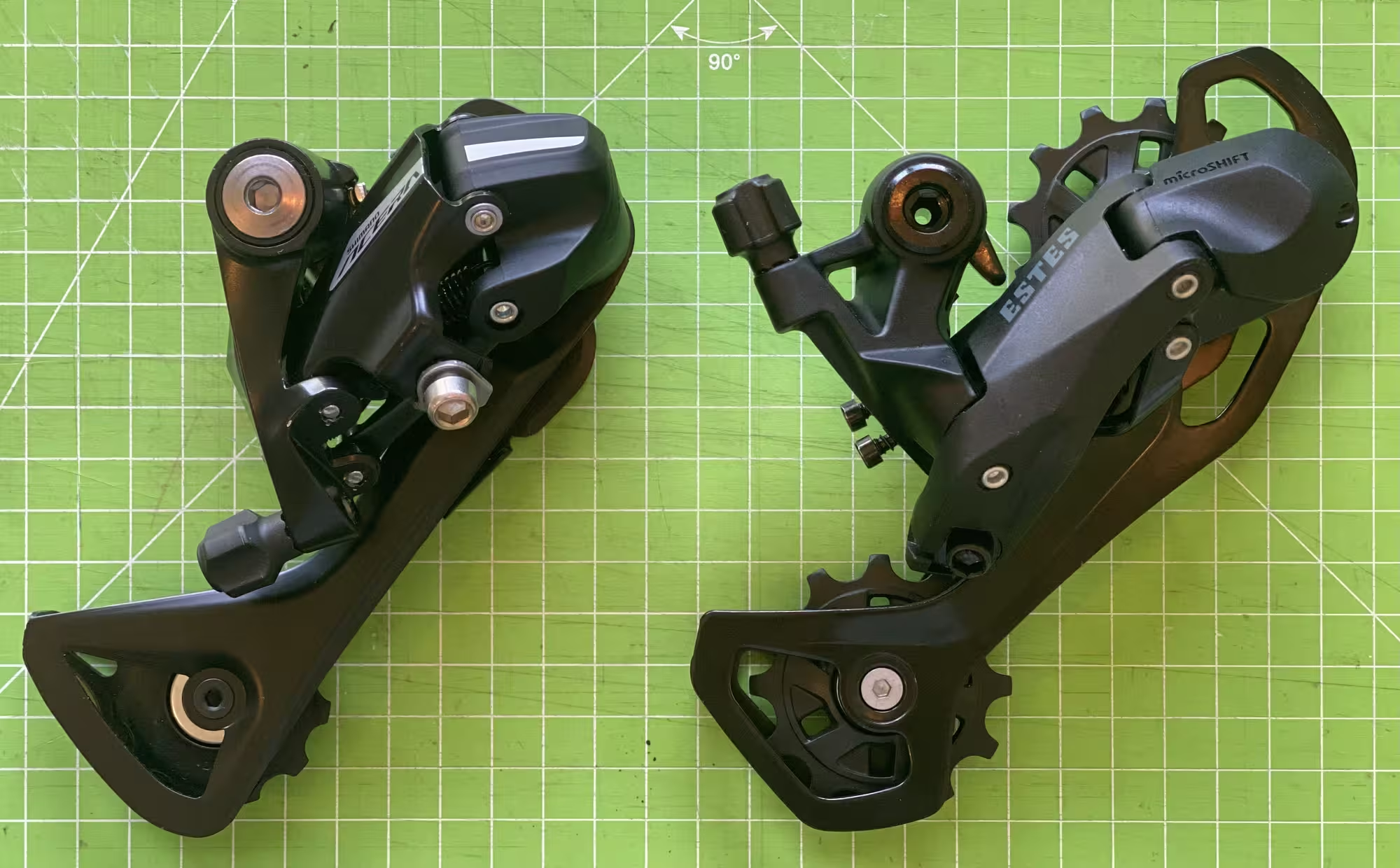
Unlike the previous Acera RD-M360, which had 13-teeth pulley wheels, somehow the new Acera, while increasing its officially supported maximum cog size, has gone back to 11-teeth ones. (Don’t forget that even the Altus RD-M310 features 13T/15T pulley wheels.) Here, Microshift at least went with 12 teeth at the cost of weighing 12% more despite using plastics instead of the all-metal construction employed by Shimano. Additionally, it not only is a bit larger, it also has a less sleek appearance.
| Acera RD-M3020 | Estes RD-M220L | |
|---|---|---|
| Weight | 286g | 320g |
| Body material | Metal | Plastic |
| Guide pulley wheel | 11T | 12T |
| Tension pulley wheel | 11T | 12T |
| Total capacity | 45T | 45T |
| Max. front difference | 20T | n/a |
| Large cog | 30–40T | 34–40T |
| Small cog | 11–12T | 11–14T |
| Adjustment screw heads | Phillips | 3mm hex socket |
| Cable routing | From behind | From the top |
| Color | Black with silver | All black |
| Clutch | No | No |
Low and wide-range gearing
Both derailleurs form the perfect base for cheap low and wide-range gearing without having to exceed the manufacturer’s specifications. Yes, it will be gappy as the Acera CS-HG400 8-speed cassette has a cog spacing of 11-13-15-18-22-27-33-40, resulting in a maximum jump of 23%. (You could try a 9-speed cassette, which is less common in a 11–40 format or go for more speeds with friction shifting. Both options will be more expensive, though.) If you like to take it to the extreme like me, I recommend using a 104/64mm-BCD crankset. (Sadly, the 96/58mm-BCD configuration has become quite uncommon, thus resulting in expensive chainrings.) This allows for a readily available smallest chainring with 22 teeth (or the expensive 20 teeth stambecco chainring which you could make yourself using a cheap e-bike cog for the 2nd generation of Bosch motors).
The combination of a 22T chainring and 40T cog yields a development of 1.2m on a 40mm wide 28” wheel. Going for a small 20T chainring – which maxes out the derailleur’s capacity if you choose a large 36T chainring – lowers this to 1.1m allowing you to ride less than 6km/h while still pedalling at a high cadence of 90rpm. (At an assumed total weight of 100kg on a gradient of 15% this would mean having to output about 260W.) Have a look at Ritzelrechner to play around with this.
To reduce the gear jumps in the 8-speed cassette, I’m considering trying out a half-step plus granny configuration with an additional 39T third chainring. This would exceed the stated maximum capacity by one or three teeth. However, for this experiment I have yet to stumble upon a cheap chainring in a 104mm BCD which isn’t made out of heavy steel or has narrow-wide teeth.
Conclusion
If you don’t particularly want the 3mm hex sockets for the adjustment screws and larger pulley wheels, you might as well stay with Shimano as it is lighter and made out of metal. I’ve so far only rode the Acera with its own shifter and the Estes with its shifter. To really assess if one is better than the other, I will mix them up in the near future. But the Estes shifter itself feels nice and has very little play. Just the multi-release is a bit sensitive which is why I sometimes downshift two gears at once even if I didn’t mean to.